The promise of DIY website builders is seductive: drag a few boxes, drop a few images, launch in an afternoon, and wait for the leads to roll in. For many Wilmington, NC business owners, it feels like real progress… until the silence sets in.
The phone doesn’t ring. Contact forms stay empty. You search for your business on Google—and you’re nowhere.
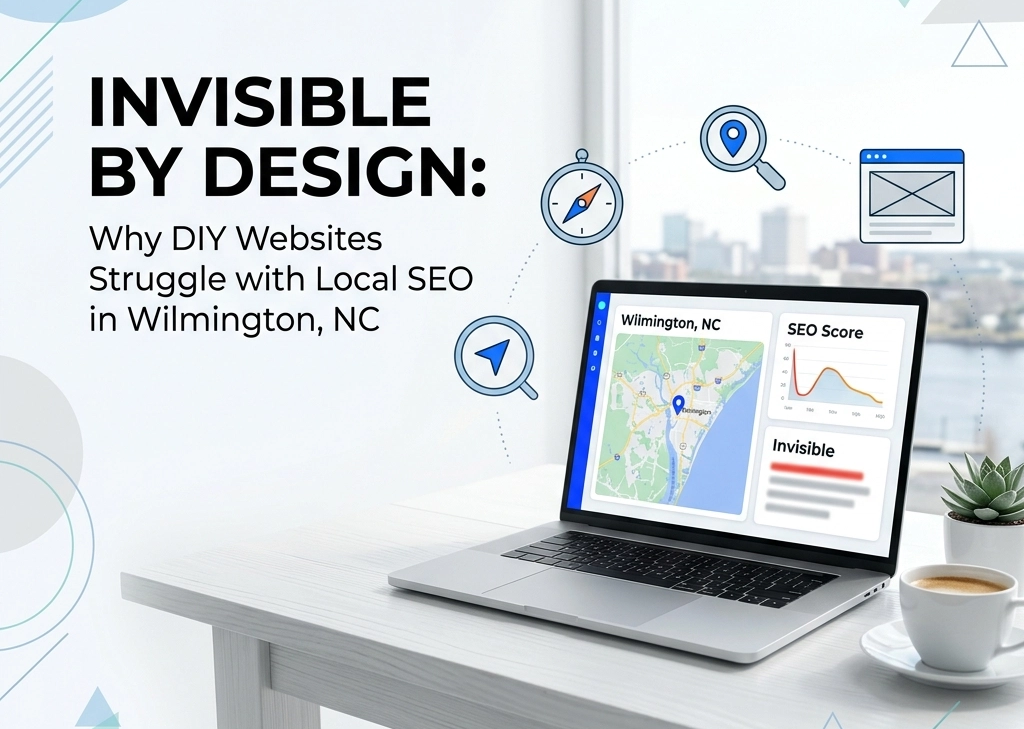
This is what it means to be invisible by design.
At SiteGooRoo, we see this pattern often: attractive DIY websites wrapped around a hollow technical core. To understand why these sites fail to rank—especially in a competitive, hyper-local market like Wilmington—we have to look beneath the surface.
The Architecture of Invisibility
A website is not just a digital brochure. It’s infrastructure.
When you build on a DIY platform, you are not constructing a custom home; you’re renting a room in a pre-fabricated complex. You get convenience, but you surrender control over the foundation. That foundation is where SEO either thrives—or collapses.
Most DIY website builders are optimized for ease of use, not for search engine clarity. They prioritize:
- Visual drag-and-drop layouts over clean code
- Quick launch over long-term scalability
- Design presets over technical customization
They’re engineered for looks, not findability.
The Hidden Cost: Technical SEO Debt
In finance, debt eventually comes due—with interest. The same is true for web design.
Technical SEO debt is the accumulated cost of shortcuts taken in the build process. DIY platforms are built on a mountain of these shortcuts. To make drag-and-drop tools work, they generate:
- Excess JavaScript for simple layout changes
- Multiple CSS layers for minor style tweaks
- Nested divs and containers that serve no real purpose
To a search engine like Google, this is noise. Every extra layer of code adds friction to how your site is crawled, indexed, and rendered.
The result? Your site looks fine to a human but feels sluggish and disorganized to the search engine that decides whether you show up in Wilmington’s local results.
Why Page Speed is a Local Ranking Issue
Page speed is not just a user experience metric—it’s a ranking factor, especially on mobile.
When your DIY site takes four or more seconds to load because of bloated scripts and oversized images, three things happen:
- Users bail early. They hit back and choose a competitor that loads instantly.
- Engagement signals drop. High bounce rates and low time-on-page tell Google your site isn’t providing value.
- Core Web Vitals suffer. LCP, CLS, and FID all degrade, which can suppress rankings.
In a market like Wilmington—where many of your competitors are investing in technically sound sites—you’ve already lost the race before it starts.
Want to see common pitfalls? Review our in-depth guide on Wilmington, NC web design mistakes to understand how these technical issues show up in the real world.
The Template Paradox
Templates are the white-cube galleries of the DIY web. Clean, minimal, pre-arranged.
They offer a polished starting point, but they come with a paradox: they’re designed for the masses, not for the specific context of Wilmington, NC.
The Signal-to-Noise Problem
Local SEO depends on clear, structured signals that tell Google:
- Who you are
- Where you are
- Whom you serve
- What you’re best known for
A generic template is a rigid container. When you pour your unique business data into it, that data often gets diluted.
Most DIY templates only offer surface-level SEO options, such as:
- Basic page titles and meta descriptions
- A single location field, at best
- Limited control over structured data or schema markup
But effective local SEO in Wilmington requires deeper hooks, including:
- LocalBusiness schema: Marking up your business type, location, and contact details.
- ServiceArea schema: Defining neighborhoods, cities, or ZIP codes you actually serve.
- Location-specific landing pages: Targeting areas like Wrightsville Beach, Carolina Beach, or Downtown Wilmington.
When your platform doesn’t support these elements—or buries them behind “advanced” settings—your site remains a digital business card, not a 24/7 sales engine.
Outcome: Weak Performance in Local Clusters
Local search results in Wilmington aren’t global; they’re clustered.
Whether you’re:
- A law firm on Front Street
- A boutique in Wrightsville Beach
- A contractor serving Ogden and Monkey Junction
You’re not just competing with the internet at large. You’re competing with the three to five local businesses that show up in the map pack and top organic results.
Those businesses usually have:
- Custom or semi-custom sites with clean code
- Dedicated local pages
- Professional schema and technical SEO in place
DIY sites often lack the layout spine to support this complexity. They struggle to:
- Logically connect your physical address to your service area
- Showcase reviews, FAQs, and trust signals in a structured way
- Create internal link pathways that reinforce your authority in a niche
Without that spine, Google has less reason to trust your business as a top result.
The Wilmington Context: Why “Good Enough” Fails
Wilmington is not a generic market. It’s a layered ecosystem:
- Seasonal tourism and hospitality
- Professional services (legal, financial, medical)
- Trades and home services
- A growing tech and creative scene
In a town of this size, your reputation spreads quickly offline. Online, that reputation is mediated by two main assets:
- Your Google Business Profile (GBP)
- Your website’s local authority
If either one is weak or inconsistent, your visibility suffers.
The NAP Consistency Trap
NAP stands for Name, Address, Phone.
Local SEO success depends on NAP consistency across:
- Your website
- Your Google Business Profile
- Local directories (Yelp, Bing Places, Apple Maps)
- Niche directories (Avvo for attorneys, Healthgrades for medical, etc.)
DIY site owners often try to manage this manually. That leads to subtle inconsistencies, such as:
- “St.” on the website vs. “Street” on Google
- Different phone number formats (910-555-1234 vs (910) 555-1234)
- Old suite numbers or outdated addresses lingering on secondary listings
To a human, these differences look trivial. To Google, they read as conflicting records.
Confusion leads to doubt. Doubt leads to lower rankings in the local pack. A professional approach uses tools and systems to keep NAP synchronized with clinical precision.
Static Sites, Static Rankings
Many DIY websites are built in a single burst of energy and then left alone.
Local SEO, however, is fueled by a content engine, not a one-time launch. Without ongoing content, your site starts to look abandoned in the eyes of search engines.
The key missing elements are:
- Location-specific blog posts (e.g., “How Wilmington’s Humidity Affects Roof Lifespans”)
- Service pages tailored to different neighborhoods or use cases
- Evergreen resources that attract backlinks and repeat visitors
Search engines reward sites that:
- Publish consistently
- Address local questions
- Build topical authority around their services and geography
A static DIY site can’t compete with a Wilmington business publishing high-quality, localized content every month.
The Human-Centric Design Gap
There’s another dimension to invisibility: what happens after someone lands on your site.
A DIY website might look “nice” in a generic sense, but it’s rarely shaped around the psychology of your actual Wilmington audience.
Human-centric design asks questions like:
- What is someone in Wilmington actually trying to accomplish on this page?
- What doubt or friction might prevent them from calling or filling out a form?
- How can we guide them to action with subtlety instead of shouting at them?
Quiet Conversion vs. Loud Decoration
Professional design for local businesses focuses on quiet conversion, not decorative noise. That means:
- Clear, localized headlines that speak directly to Wilmington problems
- Thoughtful use of social proof (local testimonials, recognizable landmarks, partner logos)
- Simple, frictionless pathways to the next step (call, book, request a quote)
DIY templates tend to overdo:
- Sliders and animations that slow down the site
- Stock imagery with no local relevance
- Generic copy that could apply to any city—or any industry
When design is all improvisation and no intention, visitors drift instead of deciding.
Forensic Review: The Science Behind Search
Professional web design is less about decoration and more about engineering. At SiteGooRoo, we approach websites like forensic analysts, not interior decorators.
A forensic SEO review looks at:
- Semantic HTML: Is your code structured so Google can “read” your site like a clear, logical document?
- Asset optimization: Are your images compressed, properly sized, and labeled with meaningful alt text?
- Local schema: Is your location, business type, and service area hard-coded into the site’s DNA?
- Conversion pathways: Does your design lead users toward a clear, appropriate action—without overwhelming them?
This isn’t about adding more plugins to an unstable template. It’s about designing a system where every element has a job.
Moving from Noise to Signal
If you built your own site and you’re not seeing results, it isn’t a personal failure. You’re simply working within the limitations of tools that were never designed for competitive local SEO.
Improvisation is powerful in art or music. In digital growth, uncontrolled improvisation creates friction.
Transitioning from DIY to a professional digital asset is a shift:
- From bloated to intentional code
- From static pages to a living content strategy
- From guesswork to measurable outcomes
It’s also a shift in how you use your time. Instead of wrestling with templates, updates, and SEO settings, you can focus on your business—while your website quietly builds authority for you in the Wilmington market.
Why DIY Can’t Keep Up with 2026 Search
Search in 2026 is no longer just “10 blue links.”
AI-driven results, conversational search, and richer local experiences mean Google is looking for structured, context-rich, trustworthy data. DIY templates struggle to deliver this because they:
- Limit access to structured data and schema control
- Make it hard to integrate advanced tracking and analytics
- Encourage superficial optimization instead of strategic architecture
In a world where AI systems increasingly summarize and recommend local providers, any ambiguity or technical weakness can push your business out of the shortlist.
A Measured Invitation
If your Wilmington business is currently invisible, the issue is rarely solved by a new template or another round of DIY edits. The invisibility is rooted in structure, not surface.
These are not “minor tweaks.” They are fundamental gaps in how the modern web operates.
You deserve a partner who values clarity, calm, and human-scale results. A partner who understands that local SEO and AI-enhanced search demand a level of precision that off-the-shelf templates simply can’t provide.
Secure Your Forensic Review
Ask yourself a simple question: is your website working for you—or quietly working against you?
At SiteGooRoo, we offer more than design. We offer assurance grounded in data, not hype.
Here’s what a forensic review of your current site typically uncovers:
- Where technical SEO debt is slowing you down
- How your local signals (NAP, schema, content) are being interpreted
- What’s missing for you to compete effectively in Wilmington’s local clusters
From there, we provide a clear, jargon-free roadmap for turning your site from an invisible brochure into a visible, trusted local asset.
If you’re ready to step away from DIY frustration and toward a measured, deliberate digital presence, it starts with a simple step.
Ready to become visible?
Get your free Website SEO Audit at SiteGooRoo.com and see exactly what’s holding your Wilmington business back—and how to move from invisible by design to visible by intention.