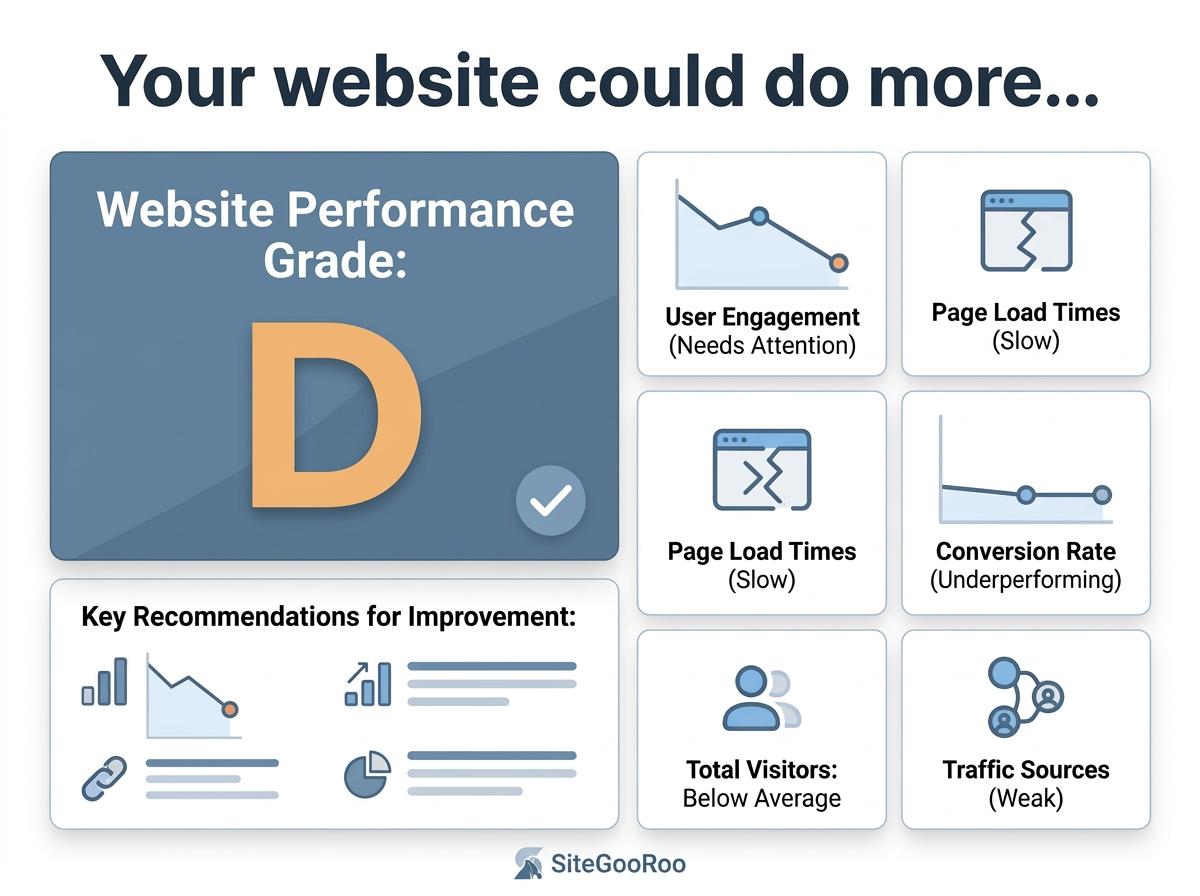
Your Website Works Every Hour — But Is It Working Well?
Your website is on the clock 24/7. It answers questions while you sleep. It greets visitors before your office opens. It builds trust, guides decisions, and creates opportunities for calls, bookings, and purchases. But here’s the uncomfortable question: is it doing those things effectively?
Many business owners assume that if the site looks decent on a desktop and the phone number is visible, they’re covered. That assumption can be costly. A website can look perfectly fine while quietly underperforming in ways that cost you leads, rankings, and revenue.
A professional website design audit removes the guesswork. It gives you a clear, measured picture of what’s working, what’s creating friction, and how your digital presence compares to competitors in North Carolina and beyond. No vague scores. No technical jargon overload. Just a clearer view of the asset you already own.
The Hidden Problem: A Website Can Look Fine and Still Fail
Let’s be honest — most business owners judge their website by appearance. The logo is there. The colors match. The pages load on a laptop. So it must be fine, right?
Not necessarily. A website can look acceptable while suffering from any of these silent issues:
- Slow loading on mobile devices — visitors lose patience and leave
- Unclear navigation — key services are buried under vague menu labels
- Hard-to-find contact info — phone numbers and forms hidden below the fold
- Weak page titles and descriptions — search engines can’t understand your pages
- Broken links or technical errors — crawlers get confused, users get frustrated
- No clear value proposition — visitors can’t tell why they should choose you
- Inconsistent experience across devices — what works on desktop breaks on mobile
- Less clarity than a nearby competitor — they simply make it easier to understand what they offer
These issues create quiet losses. A potential patient picks another medical practice because the booking process feels clunky. A homeowner calls a contractor whose service area is clearly spelled out. A client chooses a law firm whose website feels more current and trustworthy.
You may never know the opportunity was there. That’s why a website audit matters — it brings invisible problems into view before they consume more time, money, and missed chances.
Small issues reduce rankings, conversions, and trust. An audit reveals them.
What a Professional Website Audit Actually Reveals
A thorough audit — like the one SiteGooRoo performs — checks more than 100 items. But the goal isn’t to overwhelm you with technical details. It’s to translate those findings into a short, actionable list of priorities.
1. Search Visibility: Are You Even on the Radar?
Search engines need clear signals to understand your business, services, and location. An audit reviews core elements like:
- Page titles and meta descriptions
- Heading structure (H1, H2, etc.)
- Keyword coverage and relevance
- Image alt text and file names
- Internal linking structure
- Content gaps and thin pages
- Indexing and crawlability issues
- Broken links and redirects
- XML sitemap health
- Duplicate or missing content
For a local business, the audit also considers local relevance. Does your website clearly state where you work? Does it reference the neighborhoods, communities, or service areas you cover? Are your business name, address, and phone number consistent across your website and local listings?
A technically sound website gives search engines a solid foundation to match your business with the right local searches. If your site has crawl errors or missing meta tags, you’re invisible to the very people looking for you.
2. Mobile Experience and Speed: The Make-or-Break Factor
A huge share of local website visits starts on a phone. That visitor might be standing outside your office, sitting in a driveway, or comparing three providers before making a decision. The mobile experience must be calm, immediate, and friction-free.
The audit checks:
- Responsive layouts that adapt to any screen size
- Mobile page load speed
- Tap target sizes (buttons that are easy to hit)
- Menu usability and navigation on small screens
- Form functionality on mobile
- Content readability without zooming
- Visual stability (no unexpected layout shifts)
- Core Web Vitals metrics
A page that shifts while someone tries to tap a button creates frustration. A form that doesn’t work on a phone means a missed lead. A slow page gives visitors time to reconsider — and they usually do.
Good design isn’t just what visitors see. It’s how little effort they need to use your site.

3. Conversion Paths: Turning Visitors into Customers
A website can attract plenty of traffic and still fail to generate leads. That happens when the route from interest to action is unclear.
A professional audit examines your conversion paths with practical questions:
- Is it obvious who you serve?
- Is it clear what you offer?
- Is the primary next step visible on every page?
- Can visitors call you with a single tap?
- Is the contact form short and easy to complete?
- Can patients request an appointment without hunting?
- Do prospective clients understand what happens next?
- Are trust signals placed near important decisions?
The best layouts have a spine. Each page should guide visitors through a deliberate sequence:
- Recognition — “This business can help me.”
- Confidence — “This business understands my problem.”
- Action — “I know what to do next.”
When those steps are missing, your website becomes a collection of pages rather than a working business asset.
How Your Website Stacks Up Against Local Competitors
A useful audit doesn’t look at your website in isolation. It examines the digital landscape around you.
For a Wilmington, NC business, that might include nearby law firms, physicians, contractors, restaurants, creative professionals, nonprofits, or service providers competing for the same attention. The comparison can reveal:
- Page clarity and structure
- Mobile usability and speed
- Loading performance
- Service descriptions and detail level
- Contact options and ease of reaching out
- Local search signals (NAP consistency, reviews, citations)
- Trust elements like testimonials and certifications
- Navigation and information architecture
- Visual consistency and brand presentation
- Calls to action and their prominence
- Content quality and depth
The purpose isn’t to copy another business. It’s to identify the standard your customers already experience elsewhere. A competitor may not have better credentials, service, or expertise. Their website may simply make those strengths easier to understand.
That distinction matters. The strongest local website isn’t always the loudest — it’s often the one that creates the least uncertainty.
Why a Professional Audit Beats a DIY Check
DIY tools like Google PageSpeed Insights or SEO checkers can be useful. They can flag a missing meta description, identify a slow page, or show whether your site is mobile-friendly. They provide data.
But data alone doesn’t provide direction.
A professional audit adds context. It connects technical findings to your goals, customers, market, and brand. It answers the “so what?” question that raw data can’t.
For example:
- A tool reports that a page lacks internal links. A professional explains which pages should connect, why the relationship matters, and how to restructure navigation so visitors move with less effort.
- A tool shows a slow load time. A professional identifies whether the cause is oversized images, unnecessary scripts, hosting limitations, or a page structure that needs refinement.
- A tool reveals that a competitor has more local content. A professional helps determine whether you need a new service page, a clearer location page, or a more focused content strategy.
This is the difference between a checklist and a review. The checklist produces findings. The review produces priorities.
The SiteGooRoo Approach: A Clear Three-Phase Audit
We keep the process simple and transparent.
Phase 1: Scan
We review your website across more than 100 checks covering SEO, content, speed, mobile usability, technical health, social signals, and local visibility. This gives us a comprehensive view of your digital presence.
Phase 2: Interpret
We translate the results into plain English. You don’t need to understand every technical term to understand what deserves attention. We explain what each finding means for your business and your customers.
Phase 3: Prioritize
You receive a practical action list organized by importance. This list helps you:
- Make improvements yourself
- Direct your internal team
- Brief a developer
- Plan a redesign
- Decide where professional support will create the most value
Priorities, not a long spreadsheet.
That principle keeps the audit useful. A website doesn’t need more noise. It needs a measured plan.
The Outcome: Better Decisions Before You Spend
A free website design audit is not a redesign proposal disguised as a report. It’s an opportunity to understand your current position before investing more time or money.
The findings may show that your website needs only focused improvements:
- Clearer calls to action
- Better page titles
- Stronger service descriptions
- Updated images
- Improved mobile spacing
- Faster-loading media
- Simpler contact forms
Or they may reveal deeper structural problems that would benefit from custom web design and development.
Either way, you gain assurance. You know which problems matter. You know which changes can wait. You have a clearer basis for your next decision.
That’s valuable for a small business owner managing a practice, studio, office, storefront, or service team.
Make Your Website Work Around the Clock
Your website should not function as a digital business card that simply confirms your name and phone number. It should help people understand your value, find the information they need, and take the next step — whether that’s calling your office, requesting a quote, booking an appointment, or starting a conversation.
It should work quietly in the background, building trust and converting interest into action.
A high-performing digital asset doesn’t rely on pressure. It creates confidence through clarity, rhythm, and intent. That’s what SiteGooRoo helps local businesses achieve — combining technical precision with human-centered design.
If you serve Eastern North Carolina, or customers beyond the region, the first step is a clear view of where your website stands today.
Request Your Free Website Design Audit
Don’t spend more money on a website you’ve never properly evaluated. Request a free website design audit from SiteGooRoo to see how your website performs, where it creates friction, and how it compares with the digital standard in your market.
You’ll receive a straightforward review, plain-language findings, and prioritized next steps — with no obligation.
Request your free audit today and find out whether your website is working for you 24/7.