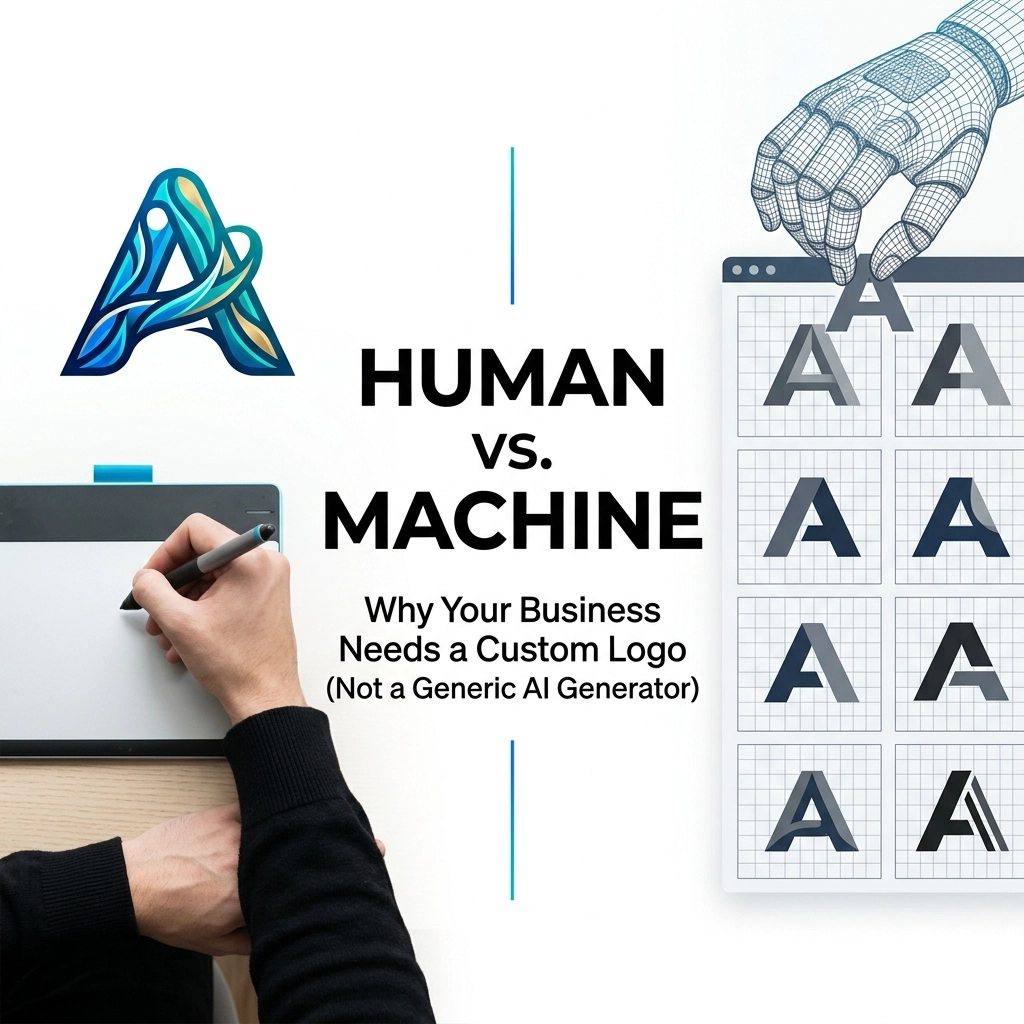
Efficiency is often mistaken for effectiveness. Cheap is not better. Custom logo designs are not always expensive. Your brand deserves quality.
In the digital landscape of 2026, the barrier to entry for “design” has never been lower. You can type three keywords into a prompt and receive a logo in four seconds. It’s fast. It’s cheap. And for many serious businesses, it’s a quiet catastrophe waiting to happen.
A logo is not a decorative file that lives on your desktop.
It is the visual tempo of your entire business — the first, most persistent signal your market receives about who you are, what you value, and whether they should trust you.
The Illusion of the “Instant” Brand
AI logo generators promise something incredibly seductive: a shortcut to a “professional-looking” identity. But like most shortcuts in business, the ease comes with tradeoffs you only see once real stakes are involved.
AI operates on a diet of averages.
It consumes vast datasets of existing marks, identifies common patterns, and then recombines them into something that feels familiar. That “familiar” feeling is exactly the problem.
Why Generic Logos Are a Strategic Risk
When your logo is built from statistical averages:
- You look interchangeable. If your mark could belong to any law firm, med spa, or boutique in America, it doesn’t belong to you.
- You invite confusion. Visual similarity erodes brand recall. If clients can’t quickly distinguish you from competitors, you lose mindshare — and revenue.
- You dilute your story. AI can mimic style but not substance. It has no grasp of your origin story, your values, or the stakes your customers are facing.
An algorithm cannot understand the nuance of your specific market in Wilmington, NC, or the coastal pulse of Myrtle Beach. It doesn’t feel the heritage of a multi-generational family business or the ambition of a disruptive startup.
AI produces shapes.
Humans produce signals.
Strategy Over Syntax: What a Real Logo Process Looks Like
A custom logo design Wilmington, NC business owners can rely on doesn’t start with colors or fonts. It starts with a forensic look at your brand’s soul.
Think of your logo as the layout spine of your business. If the spine is crooked, everything else — your website, social media, signage, ads, print materials — develops a visual limp. Nothing quite lines up, and your brand never feels “put together,” no matter how much you spend.
A human-led logo process is:
- Deliberate, not reactive
- Strategic, not purely aesthetic
- Market-aware, not just “pretty” on a screen
The goal is simple: your logo should begin communicating your value proposition before a single word of copy is read.
Path A: New Businesses — Building on Bedrock, Not Sand
If you’re launching a new business, the blank canvas is both an opportunity and a risk. This is often where AI logo generators feel most tempting: “I just need something quick to get started.”
Why Starting with an AI Logo Backfires
Using a generic AI mark is like building a house on sand:
- It may look “fine” in the beginning.
- The moment you try to scale — new locations, new marketing channels, merchandise — the cracks appear.
Common issues include:
- No legal defensibility. If your logo looks like dozens of others, trademark registration becomes difficult or impossible.
- Zero long-term strategy. The mark doesn’t anticipate future offerings, locations, or growth.
- Inconsistent application. You realize too late that it doesn’t adapt well to small sizes, dark backgrounds, or different media.
What New Businesses Actually Need
A serious brand identity for a small business should be:
- Legally defensible. Uniqueness matters. A professional designer researches competitors and potential conflicts before finalizing a mark.
- Visually distinctive. You don’t just want “a logo”; you want your logo — something ownable and memorable.
- Built for growth. A well-designed logo anticipates how it will live on your site, vehicles, uniforms, proposals, and social feeds.
When your logo is treated as an asset — not a placeholder — it becomes a foundation you can confidently build on for years.
Path B: Established Businesses — Evolving Without Losing Your Roots
If you’ve been in business for a decade or more, your existing logo is a legacy asset. Maybe it was designed when your website was still “mobile-optional,” or when gradients and drop shadows were the cutting edge.
A professional logo redesign is not about erasing that history.
It’s about distilling it.
Problems Legacy Logos Often Create
As markets and mediums evolve, older logos can start to create friction:
- They don’t scale well. Fine details that worked on letterhead disappear on phones.
- They feel visually dated. Aesthetic trends change, and an outdated look can imply outdated operations.
- They don’t reflect what you’ve become. Maybe your services have expanded, your clientele has shifted, or your geographic focus has grown.
Strategic Modernization, Not Random Makeover
A thoughtful logo evolution for a Myrtle Beach or Wilmington business:
- Identifies what visual elements your customers already associate with trust
- Retains the equity in those elements (colors, symbols, initials, etc.)
- Simplifies, clarifies, and modernizes the mark for today’s digital realities
The result isn’t “something new just because.” It’s a refined visual language that honors your past while making your future easier to market.
Why Human-Led Design Wins (and Where AI Fails)
When you choose a human-led process, you aren’t just buying a graphic; you’re investing in a strategic partnership. That partnership pays off in four key areas.
1. Contextual Intelligence
AI has no sense of place or context.
It doesn’t know that the visual expectations of:
- A Wilmington medical practice require steadiness, cleanliness, and trust, while
- A Myrtle Beach surf shop thrives on energy, movement, and personality.
A human designer can:
- Study your competitors and intentionally differentiate you
- Understand local culture, regional aesthetics, and audience expectations
- Use the psychology of color to trigger the right emotions (calm blues for trust, vibrant oranges for energy, deep greens for stability, etc.)
Context is not a style; it’s a strategy. That’s where humans win decisively.
2. Technical Precision
Many AI-generated logos collapse when they leave the screen.
They look fine in a square social media avatar, but become a problem when you try to:
- Embroider them on a polo shirt
- Print them on a billboard or vehicle wrap
- Cut them from vinyl for your storefront
- Use them in a favicon or app icon
A professional logo is designed as a high-leverage asset:
- Built as clean vector artwork (typically in formats like SVG, AI, EPS)
- Tested at both tiny and massive sizes
- Delivered in color, black, white, and single-color variations
- Designed to work on light and dark backgrounds
The goal: you can scale it from a business card to a stadium banner without losing clarity, legibility, or impact.
3. The Iterative Rhythm
AI gives you a single “take it or leave it” output. A human-led process builds in iteration.
A strong logo engagement typically includes phases like:
- Discovery – Understanding your story, audience, competitors, and goals.
- Concept Development – Creating multiple distinct concepts that express different strategic directions.
- Revision Rounds – Refining the chosen direction through structured feedback.
Those revision rounds are where the real magic happens. You react, clarify, and sharpen. The designer interprets, simplifies, and aligns. Together, you tune the visual tempo of your brand into something that feels undeniably “you.”
That is something no one-click generator can reproduce.
4. Custom Pricing for Custom Needs
AI tools are usually priced as flat subscriptions or one-size-fits-all packages. Many design services mimic this with “Bronze, Silver, Gold” bundles. The problem? Your business rarely fits neatly into a prebuilt box.
Human-led logo design can be scoped around:
- Your business size and complexity
- The number of decision-makers involved
- The breadth of deliverables (logo only vs. full brand system)
- Your timeline and market pressures
A solo practitioner in Wilmington has different needs than a 50-employee firm in Myrtle Beach. Custom pricing allows the work to reflect your reality — not a template.
The Legal and Strategic Safety Net
One of the riskiest aspects of AI logos is exclusivity — or the lack of it.
Because AI systems generate from existing patterns and combinations:
- There is a real chance something very similar has been generated for someone else.
- That similarity may not be obvious until a conflict appears.
In the world of trademarks, this is a minefield.
Copyright and Ownership Gray Areas
AI-generated art currently resides in a legal gray zone in many jurisdictions. Key issues include:
- Who owns the output? You, the platform, no one?
- Is it protectable? Many AI outputs struggle to meet the originality threshold for copyright or trademark.
By contrast, when you work with a professional designer under a clear agreement:
- The authorship is human and traceable.
- Ownership and usage rights are defined.
- You can pursue trademark protection with far greater confidence.
Protecting Your Brand in the Real World
A custom logo isn’t just about avoiding lawsuits; it’s about:
- Protecting your reputation from lookalikes
- Preventing customer confusion
- Creating an asset you can confidently put on your building, vehicles, and marketing
A thoughtful design partner will also ensure your logo works in harmony with your digital presence, avoiding common Wilmington, NC web design mistakes where the logo and website feel like they belong to two different companies.
Beyond the Icon: A Holistic Brand Vision
A logo is the lead-off hitter, not the entire team.
If you treat it as a standalone artifact, you miss its real power. A strategic logo should:
- Lead naturally into a high-performing website
- Look authoritative on lead-generating landing pages
- Integrate seamlessly into your social media and ad creative
- Anchor your visual asset library — icons, patterns, typography, and more
Designing for the Entire Customer Journey
A modern brand ecosystem spans:
- Search results and SEO – How your logo appears in knowledge panels, map listings, and rich snippets
- Social platforms – How it reads in a tiny circular avatar or as part of a cover image
- User experience (UX) – How it lives inside navigation bars, mobile headers, and app interfaces
- Offline touchpoints – Signage, proposals, brochures, uniforms, and trade show materials
A data-informed design partner will consider all of these environments when crafting your logo, not just the “hero shot” on your home page.
When to Reconsider Your Logo
If your current logo feels like noise instead of a signal, it’s worth asking a few key questions:
- Do new customers ever confuse us with a competitor?
- Does our logo feel dated compared to others in Wilmington or Myrtle Beach?
- Does it still reflect what we actually do and who we serve today?
- Does it look crisp and intentional on our website, signage, and social channels?
- Could we confidently trademark it without worrying it’s “too generic”?
If you hesitate on any of these, it may be time for a forensic review of your visual identity.
How to Move from Generic to Strategic
Shifting from an AI-generated or DIY logo to a strategic, human-led identity doesn’t have to be chaotic. You can approach it in a measured, low-drama way.
Step 1: Clarify Your Brand Foundations
Before redesigning anything, take stock of:
- Your core services and ideal clients
- Your geographic focus (Wilmington, Myrtle Beach, or beyond)
- The feelings you want your brand to evoke (stability, innovation, warmth, boldness)
- The assets you already have that feel “right” (colors, typefaces, symbols)
Step 2: Audit Your Current Identity
Look at your existing logo and visual system across:
- Your website (desktop and mobile)
- Social profiles and ad creatives
- Printed materials, signage, and uniforms
Note where it feels misaligned, weak, or inconsistent. This becomes the brief for what must improve.
Step 3: Partner with a Specialist
Choose a design partner who:
- Understands small and mid-sized businesses
- Can speak to both design and digital performance
- Offers a clear process, timeline, and deliverables
- Is comfortable working within your specific markets (like Wilmington and Myrtle Beach)
Step 4: Commit to the Process
Once you engage, lean into the iterative rhythm:
- Give candid feedback.
- Be open to strategic recommendations that challenge your assumptions.
- Keep your long-term goals front and center.
The objective isn’t just “a nicer logo.” It’s a brand identity that works like a 24/7 sales engine, reinforcing your professionalism and value at every touchpoint.
Your Brand Is Too Important to Hand to a Machine
AI is a useful tool for brainstorming. It can spark ideas and explore directions quickly. But meaning — the kind that builds trust, loyalty, and growth — is still human work.
If your logo feels generic, misaligned, or like an afterthought, treating it as a disposable asset is no longer an option. In markets as competitive as Wilmington and Myrtle Beach, you can’t afford to look like everyone else.
Investing in a human-led, strategic logo design is not vanity.
It’s infrastructure.
Stop settling for generic.
Start building a visual legacy that your business can grow into — and grow with — for years to come.