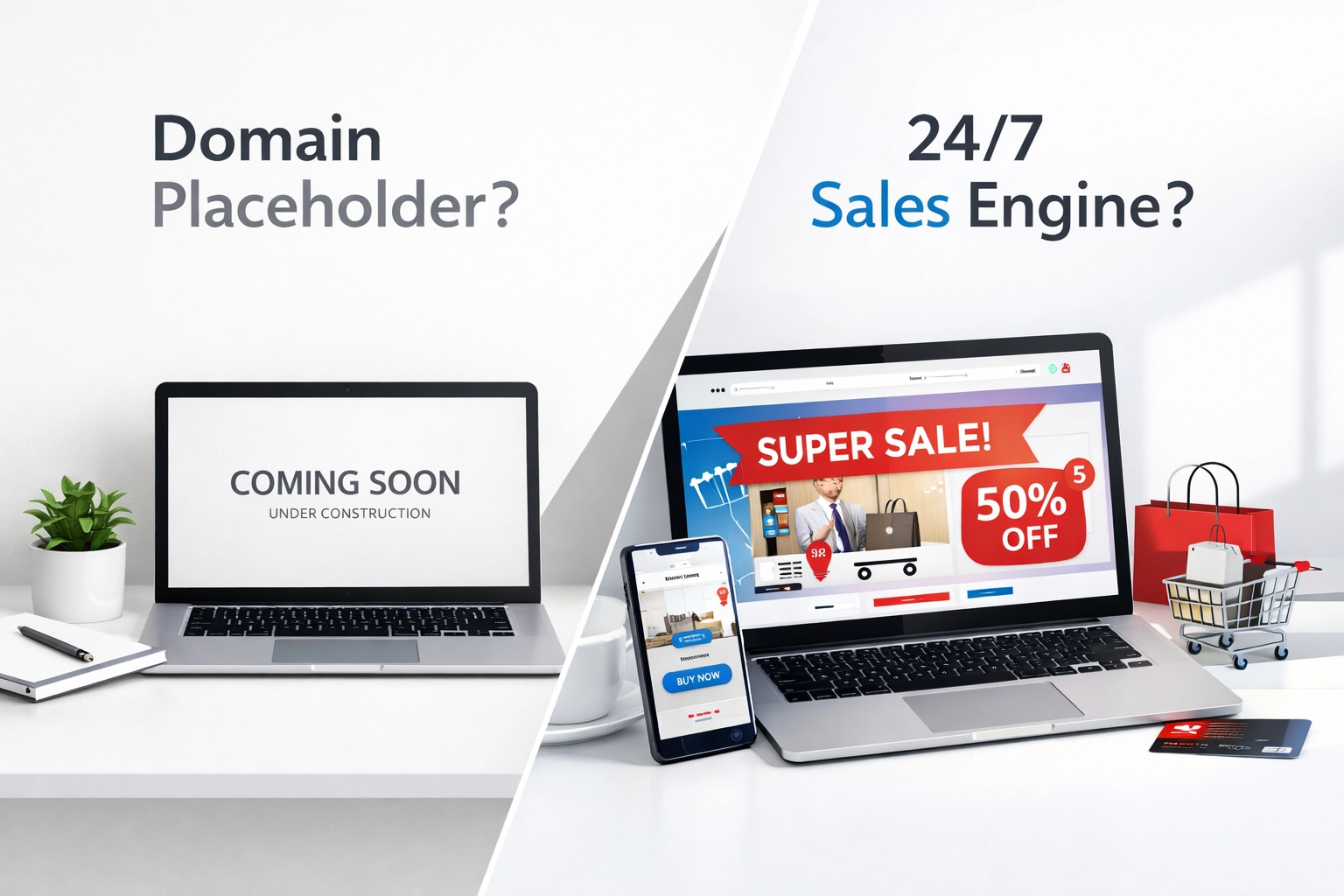
Ownership is not the same as impact. Owning a domain name and uploading a logo does not mean you have a digital strategy—it means you’ve purchased an address. Whether that address is an empty lot or a fully operational storefront determines if your website quietly exists or actively sells for you.
In the Cape Fear region and beyond, too many small businesses are settling for an online “Coming Soon” sign that never actually arrives. The question isn’t do you have a website; the question is: Is your website a placeholder, or is it a 24/7 sales engine?
Placeholder vs. Engine: What’s the Real Difference?
A domain is digital real estate. Your website is the structure built on it. But not all structures are created equal.
The Placeholder Website
A placeholder website is passive by nature. It might look like this:
- A logo at the top and a single hero image
- A short paragraph about your business
- A phone number, address, and maybe a contact form
- No real direction, no clear next step for the visitor
On the surface, it “checks the box” of having a website. Underneath, it’s costing you opportunities.
Common traits of a placeholder site:
- Low engagement metrics: High bounce rate, short time on page, minimal page views
- Generic templates: Templated themes with no real customization or strategy
- Broken foundations: Broken links, unoptimized images, missing alt text, and messy navigation
- No intent: The site doesn’t clearly guide visitors from curiosity to contact or purchase
In a world where users expect frictionless online experiences, a placeholder functions like a dusty brochure sitting on a back shelf.
The 24/7 Sales Engine
A high-performance website is an active participant in your sales cycle. It does not passively display information; it drives action.
An engine site is built to:
- Capture leads at 3:00 AM
- Answer objections before they’re even voiced
- Nurture visitors from first click to booked call or purchase
- Provide insight into where your best customers are coming from
Instead of being “nice to have,” it becomes a measurable revenue driver.
Why a Placeholder Website Is a Liability
In competitive markets like web design services Wilmington NC, a static website doesn’t just fail to help you—it actively hurts you.
The Hidden Cost of Stagnation
A placeholder website:
- Creates friction: Slow load times, clunky navigation, and outdated visuals frustrate users
- Damages perception: Visitors subconsciously connect your digital presence to your operational quality
- Loses leads silently: People leave without calling, filling out forms, or engaging with your content
When a potential customer lands on a page that is slow, unresponsive, or visually dated, they don’t just click away—they make a judgment:
“If they’re not maintaining their website, are they really on top of their business?”
You may be delivering excellent service in the real world, but your website might be telling a different story.
The Experience Gap
Your prospects are comparing you to:
- The local competitor whose site loads in under two seconds
- The brand whose site clearly explains services and pricing
- The business whose contact process feels effortless
If your site takes four seconds to load, you’ve likely already lost the lead to the business down the street whose site takes two.
The Three Pillars of a High-Performance Website
A strong digital engine doesn’t happen by accident. It’s engineered around three core pillars that turn traffic into real-world results.
1. Visual Tempo: Design That Guides the Eye
“Pretty” design isn’t enough. Effective design has rhythm—it pulls the eye toward decisive action.
Key elements of visual tempo:
- Clear visual hierarchy: Headlines, subheads, and calls-to-action (CTAs) stand out immediately
- Consistent branding: Fonts, colors, and imagery that reinforce trust and recognition
- Directional cues: Buttons, arrows, and layout flow that guide visitors down the page
- Whitespace and breathing room: Content that’s easy to scan instead of overwhelming
Ask yourself:
- Is the primary action (call, book, buy, request a quote) obvious within the first 3–5 seconds?
- Can a new visitor understand who you serve and what you do by scanning your hero section?
If not, your design isn’t just neutral—it’s working against you.
2. Structural Integrity: Speed, Stability, and Clean Code
Under the hood, your site’s code and structure determine whether it feels seamless or sluggish.
Structural integrity includes:
- Fast load times: Compressed images, optimized scripts, and lean code
- Mobile-first performance: Pages that load quickly and display correctly on phones
- Logical site architecture: Clear navigation, well-organized menus, and intuitive page structure
- Technical SEO readiness: Clean URLs, metadata, proper headings, and schema markup where appropriate
This is where many “template” sites fall apart. They look decent on the surface but are bloated with unnecessary scripts, oversized images, and clashing plugins.
Steve Jobs captured this philosophy:
“Design is not just what it looks like and feels like. Design is how it works.”
A website with strong structural integrity feels professional, long before the visitor consciously realizes why.
3. Local Authority: Being Found by the Right People
If no one can find your site, it doesn’t matter how beautiful or fast it is. That’s where local SEO services for small business come into play.
Local authority is built by:
- Optimized local pages: Service pages tailored to Wilmington, Myrtle Beach, and your specific service areas
- Google Business Profile optimization: Accurate categories, posts, reviews, and photos
- Location-focused content: Blog posts and landing pages that answer local questions and showcase regional expertise
- Consistent NAP data: Name, Address, Phone number consistent across directories
When local SEO is properly integrated, you don’t just show up as “another option”—you show up as the authoritative choice for your region.
From Placeholder to Engine: The Forensic Optimization Approach
Turning a placeholder into a 24/7 sales engine is not about slapping on a new color scheme. It requires a clinical look at what’s actually happening under the surface.
What Is Forensic Optimization?
Forensic optimization is a methodical process of diagnosing the invisible friction points that quietly kill conversions.
A website design audit service typically examines:
- Layout spine: How your pages are structured and how visitors move from one section to another
- User pathways: Where users land, where they click, and where they drop off
- Speed profiles: Load times across devices and locations, especially mobile
- Content clarity: Whether your copy answers the right questions in the right order
- Technical health: Broken links, redirects, image optimization, and crawlability
Instead of asking, “Do we like how it looks?” the questions become:
- Where, exactly, are we losing people?
- Which pages trigger action, and which ones repel it?
- How does our site compare to local competitors in speed, clarity, and authority?
Why This Matters in Wilmington and Myrtle Beach
In markets like Wilmington and Myrtle Beach, local competition is sharp. Many businesses are investing in cleaner design, faster websites, and stronger local SEO.
If your site:
- Loads slowly on mobile
- Uses outdated layouts
- Lacks clear calls-to-action
…you’re effectively inviting prospects to try the next result on Google.
A forensic audit gives you a measurable roadmap from “we think it’s fine” to “we know what to fix, and in what order.”
What a 24/7 Sales Engine Looks Like in Practice
When your website functions as a true engine, your business stops guessing and starts measuring.
The Rhythmic Flow of Data
A high-performance site provides feedback loops instead of question marks. You start to see:
- Which pages visitors land on most often
- Which calls-to-action convert best
- Which search terms and locations drive the most qualified leads
This data allows you to refine your offerings, messaging, and marketing spend with precision.
Designed for Local Dominance
With the right mix of design, structure, and local SEO:
- You rank higher for your core services in your region
- You attract visitors who are ready to buy, not just browsing
- Your brand appears credible, consistent, and trustworthy
Your website shifts from being a line item expense to becoming one of your most productive assets.
Always-On, Never-Off
Unlike any employee, your website:
- Never sleeps
- Never calls in sick
- Never forgets to follow up on an inquiry
It becomes the only member of your team that works 24/7, handling:
- Initial education
- Objection handling
- Lead capture
…before you ever speak to the prospect.
Is Your Site Actually Clocking In?
Most business owners are too close to their own brand to spot the weak points. The site that felt like a major accomplishment three years ago now blends into the background.
Meanwhile, the digital landscape keeps moving.
Ask yourself:
- Is my website actively generating leads—or just sitting online?
- Do I know my current conversion rate, bounce rate, and top-performing pages?
- Would a first-time visitor instantly understand what we do, who we serve, and what to do next?
If you’re unsure about any of these, you’re likely operating with a placeholder, not an engine.
Your Next Step: Get an Objective Performance Check
You don’t have to guess where your website is underperforming. A structured, objective audit can show you exactly where your digital presence is leaking revenue.
Here’s a simple action plan:
Request a website design audit
Get a clear evaluation of your design, structure, speed, and local SEO performance.
Prioritize fixes by impact
Tackle the high-impact issues first: load times, critical pages, and key calls-to-action.
Rebuild with intent, not guesswork
Treat your website as a sales system—every element should exist to guide the right visitor toward a clear action.
When you approach your site this way, you move from a state of simply existing online to a state of performing.
Conclusion: Turn Your Domain Into an Engine
Your domain is just the address. What matters is the engine you build on top of it.
A placeholder website might feel like “good enough,” but in reality, it’s a quiet drag on your growth—especially in competitive regions like Wilmington and Myrtle Beach. A high-performance site, by contrast, becomes your always-on sales associate: capturing leads, answering questions, and reinforcing your authority around the clock.
If you’re not sure which side your website is on, it’s time for a measured, objective look at its performance. Upgrade from a static placeholder to a tuned, high-leverage digital engine—and let your website finally start pulling its weight in your business growth.